
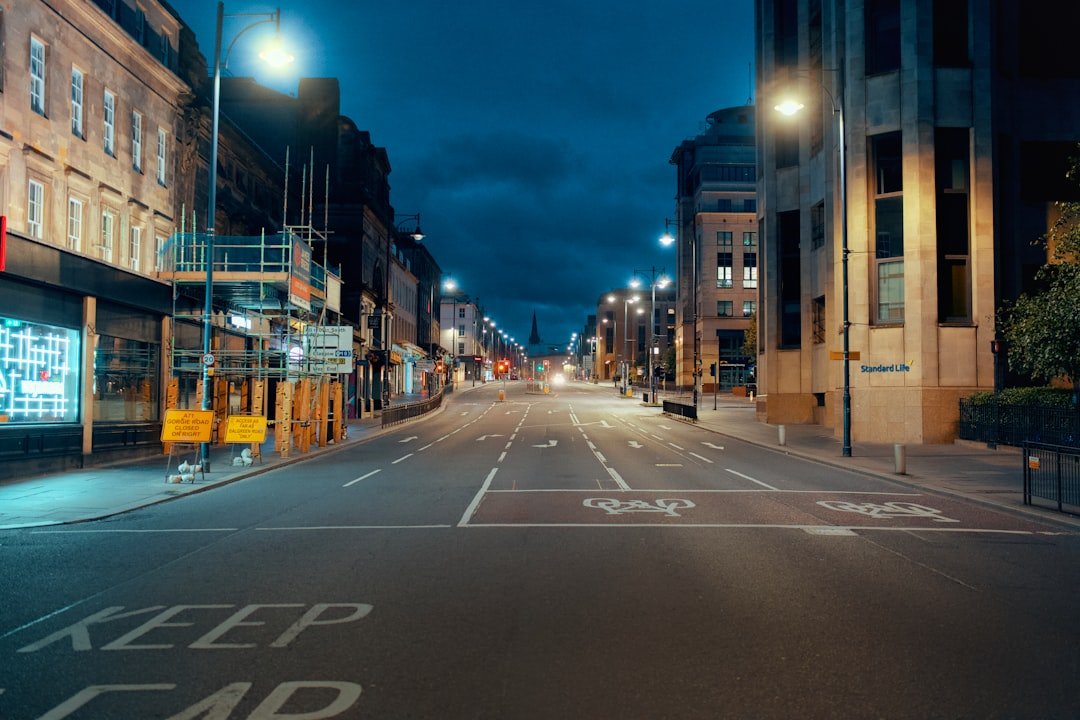
The Kerb Is Becoming Critical Urban Infrastructure
The narrow strip between the pavement and the traffic lane now carries far more responsibility than most city plans acknowledge. It must accommodate delivery vans, buses, taxis, bicycles, waste collection, tradespeople, ride-hailing vehicles, accessible parking, restaurant terraces and residents who still expect to leave a private car outside their home. On many streets, the rules governing that space were designed when the principal question was where cars could park.
That model is becoming difficult to defend. Home delivery has increased the number of short commercial stops, while ride-hailing and food platforms have added thousands of brief pick-ups and drop-offs that do not fit conventional parking categories. A driver may need the kerb for four minutes rather than four hours, yet find no legal space available. The predictable result is a vehicle left in a traffic lane with its hazard lights on, forcing cyclists, buses and other drivers to move around it.
Cities have invested heavily in roads, public transport and traffic-control systems while continuing to treat the kerb as leftover space. Its management is now influencing congestion, road safety, local commerce and the practicality of lower-emission urban logistics. The kerb has become infrastructure, but much of it is still governed by static signs and rules that remain unchanged throughout the day.
The Same Metre Of Street Serves Several Economies
A parking space has a simple function when one vehicle occupies it for a defined period. Contemporary kerb use is less orderly. A space outside a residential building may be needed for waste collection early in the morning, parcel deliveries during the day, passenger pick-ups in the evening and resident parking overnight. A street near a school, hospital or entertainment district follows a different pattern again.
Static regulation cannot respond well to those changes. A loading zone left empty outside delivery hours wastes scarce space, while unrestricted parking during the working day may leave businesses without anywhere to receive goods. A permanent taxi rank can be valuable at night and underused in the morning. The correct use of the kerb increasingly depends on the time, location and demand surrounding it.
Dynamic management allows the purpose of a space to change. Digital regulations can designate a section for deliveries during one period, passenger collection during another and general parking later in the day. Prices and permitted dwell times can also vary according to demand. A busy commercial street may require rapid turnover, while a quieter residential area can retain longer stays.
The principle is similar to traffic-signal management: public infrastructure is allocated according to current conditions rather than one fixed rule. The technology is available. The more difficult task is deciding which uses should receive priority and communicating those rules clearly enough for drivers to follow them.
Delivery Has Outgrown The Traditional Loading Zone
Commercial loading was once associated primarily with scheduled deliveries to shops and offices. The current system includes groceries, restaurant meals, same-day retail purchases, online returns, pharmacy orders and individual parcels delivered throughout the day.
The vehicle performing the work may be a branded truck, a courier van, a bicycle or a private car used by a platform worker. Rules written around conventional freight vehicles often fail to recognise this mixed fleet. A gig-economy driver may need a legal place to stop but lack the commercial permit required to use an existing loading bay.
The scarcity becomes visible in dense neighbourhoods, where delivery vehicles routinely stop in travel lanes because legal spaces are occupied or too far from the destination. In Atlanta, blocked lanes caused by delivery activity have become a prominent complaint in central neighbourhoods, with planners arguing that curb space must be managed as infrastructure rather than treated mainly as parking. The problem is not limited to one city. It reflects a street system that has not kept pace with the service economy built around rapid delivery.
A better approach begins with understanding the actual stop. How long do drivers remain? At what times does demand peak? Which buildings generate the highest number of deliveries? How often are loading spaces occupied by vehicles that are not loading?
Cities frequently lack reliable answers because kerb activity has been measured less carefully than traffic on the road beside it. Without that information, loading zones are often placed according to historical assumptions rather than current demand.
Digitising The Kerb Comes Before Managing It
A city cannot manage the kerb dynamically if it does not have an accurate digital record of what exists. In many municipalities, regulations remain distributed across signs, legal documents, parking databases and departmental maps that do not always agree with one another.
Digitisation creates a structured map of each section of kerb, including its permitted uses, restrictions, operating hours and accessibility conditions. That information can support enforcement, journey planning and applications used by commercial fleets. A delivery company could direct a driver towards a legal loading area rather than leaving them to search after arriving. A navigation service could warn that a space changes from parking to a bus zone at a particular time.
Seattle has pursued a citywide digital record of kerb regulations as part of its transport planning, reflecting a wider movement towards standardised curb data. The value lies less in producing another municipal map than in making the rules readable by the systems that direct vehicles through the city.
Accuracy is essential. A digital regulation that does not match the sign on the street creates confusion rather than efficiency. Cities need a process for recording temporary closures, construction activity, events and policy changes, together with clear responsibility for maintaining the data.
The kerb becomes part of the city’s digital infrastructure only when its physical and legal condition can be trusted.
A Reservation Can Be More Useful Than A Fine
Traditional enforcement responds after a vehicle has stopped illegally. Digital kerb systems can intervene earlier by giving the driver a practical alternative.
Smart loading zones allow authorised users to locate or reserve a space, register their vehicle and pay for the time used. The objective is not to convert every kerb stop into an advance booking. It is to give high-demand commercial areas a predictable system in which drivers know where they can stop and how long they may remain.
Washington, DC previously tested reservable commercial loading space and reported a substantial reduction in double parking during the pilot. Other cities have introduced pay-by-plate systems in which cameras or sensors recognise a vehicle and calculate the charge according to dwell time. Pittsburgh’s programme has used prices that increase as a stop becomes longer, encouraging drivers to leave once the delivery is complete.
This approach changes the incentive. A conventional fine is uncertain: many illegal stops are never observed, while the occasional penalty may simply be absorbed as a business cost. A reserved or automatically billed space offers certainty. Drivers pay a relatively small amount in exchange for access to a location that reduces search time and the risk of a ticket.
The fee should reflect the value of the service rather than operate as another punitive charge. A system that is expensive, slow to use or restricted to large fleet operators will push smaller businesses and independent couriers back into illegal stopping.
Pricing Can Protect Turnover
Free kerb space is not free in economic terms. When demand exceeds supply, drivers pay through time spent searching, uncertain access and congestion created by circling vehicles. Local businesses pay when suppliers cannot reach them reliably, while bus passengers and cyclists bear the cost when traffic and cycle lanes are obstructed.
Pricing can help manage that demand, particularly when charges vary according to location, time and duration. A short commercial stop can be priced modestly, while a vehicle occupying a high-demand loading zone for an hour faces a progressively higher charge. The aim is to reward turnover rather than maximise municipal revenue.
Dynamic pricing should be used carefully. Residents may see variable charges as an opaque attempt to monetise public space, especially when alternatives are poor. Commercial operators need predictable limits when planning routes, and small businesses should not be disadvantaged relative to large platforms able to negotiate or automate payment.
Transparency matters. Cities should explain what the charge is intended to achieve, publish performance data and show whether the revenue supports enforcement, street maintenance or local transport improvements. A system perceived as fair has a better chance of changing behaviour than one introduced as a purely technical adjustment.
Enforcement Must Become More Precise
A loading zone has little value when it is occupied by a private vehicle for several hours. New kerb policies therefore depend on enforcement, but the traditional model of officers manually observing every street cannot match the frequency of short stops.
Sensors, cameras and licence-plate recognition can identify occupancy, measure dwell times and check whether a vehicle has registered to use the space. The information can support automatic payment, warnings or enforcement after human review. It can also reveal where the city’s own regulation is unrealistic. A loading zone with constant violations may need stronger enforcement, or it may be located in the wrong place.
Automated systems raise legitimate concerns. A camera capable of recording every vehicle using the kerb creates questions about data retention, accuracy and appeal rights. Licence plates may be misread, while a vehicle stopped for an emergency can appear identical to one making a routine delivery.
Cities need clear rules governing what is collected, how long it is stored and when a penalty is issued. Human review remains important where the consequence is significant or the evidence ambiguous. Enforcement technology should make the rules more consistent, not make mistakes harder to challenge.
Legal authority can also become a constraint. Some jurisdictions do not permit automated enforcement of kerb violations even when the technology exists, leaving cities dependent on labour-intensive methods. Modern kerb management may therefore require legislative change alongside software and street design.
Better Kerb Management Can Make Streets Safer
Illegal stopping is often discussed as an inconvenience, yet its safety effects are more serious. A delivery vehicle in a cycle lane forces cyclists into traffic. A van blocking the view at a crossing makes pedestrians less visible. A bus moving around a stopped car may enter another lane unexpectedly, while congestion at school pick-up times places children among reversing and turning vehicles.
Managing the kerb can reduce those conflicts by providing designated space in the correct location. Passenger pick-up areas should be positioned where people can wait safely rather than step into a cycle lane. Loading activity should be kept away from junctions and crossings. Accessible spaces need sufficient dimensions and protection from temporary commercial use.
Physical design remains important. Digital permission cannot make an unsuitable location safe. Paint, signs, separators, raised platforms and pavement design help users understand how the space should function. In some areas, a loading bay may need to sit between the traffic lane and a protected cycle route so that deliveries do not block either.
The strongest schemes combine regulation, technology and street design. An application may direct a driver towards the space, but the street itself must still make the correct behaviour obvious.
The Kerb Can Support Cleaner Last-Mile Delivery
Urban freight policy often concentrates on vehicle emissions without resolving where the vehicle will stop. A zero-emission van blocking a bus lane still creates congestion, while an electric cargo bike needs secure access close to the destination if it is to compete with a conventional delivery vehicle.
Kerb management can support cleaner logistics by prioritising smaller or lower-emission vehicles, providing space beside micro-hubs and reserving areas for cargo-bike loading. Large trucks can deliver to a neighbourhood consolidation point, with the final distance completed by compact electric vehicles or bicycles better suited to dense streets.
Several cities are testing these models because simply replacing diesel vans with electric vans does not solve the spatial problem. The vehicle remains large, and the number of deliveries continues to grow. A more efficient last mile may require fewer large vehicles entering central areas, greater consolidation and kerb rules that reward modes using less space.
Priority should not become symbolic. A designated zero-emission bay is of limited use if it is poorly located, routinely occupied or inaccessible to the operators expected to use it. Cities need to coordinate fleet policy with actual delivery routes and the needs of businesses receiving the goods.
Local Businesses Need A Voice In The Design
Kerb reform can appear technically convincing and still fail on the street. A restaurant receives different deliveries from a pharmacy, hotel or construction site. A shop may depend on early-morning freight but need customer access later. Tradespeople require longer stops and equipment access that cannot be accommodated in a five-minute loading window.
Cities need to understand these differences before standardising the rules. Data can show the duration and frequency of stops, but conversations with businesses reveal why they occur and what would happen if access changed.
This is particularly important when parking is removed. A city may be able to demonstrate that a loading zone supports more transactions each day than one private parking space, yet the change will still be contested by people who value the previous use. Explaining the trade-off openly is more effective than presenting the decision as a neutral technological upgrade.
Pilot programmes offer a useful route. A city can test new hours, pricing or reservation rules on a limited number of streets, measure congestion and turnover, then adjust the system before expansion. The pilot should include clear success criteria so that the programme is not judged only by the number of digital transactions completed.
Equity Must Be Designed Into The System
Dynamic kerb management can favour users with smartphones, registered payment accounts and modern fleet systems. Independent tradespeople, older drivers and small businesses may find the system harder to navigate. Some residents also depend on the kerb for disability access, caregiving or work that cannot be completed through a brief scheduled stop.
A city should not assume that efficiency and fairness will arrive together. Payment and registration need accessible alternatives. Commercial permits should not be structured so that only large companies can comply easily. Data about demand should include neighbourhoods outside high-value central districts, where informal delivery activity may be less visible but equally important.
Enforcement patterns also require scrutiny. Automated systems may apply rules more consistently, but the placement of cameras and zones still reflects policy choices. If technology is concentrated in lower-income districts or penalties fall disproportionately on workers with little control over delivery schedules, the programme will lose legitimacy.
The kerb is public space. Managing it more actively requires a clear account of whose access is being improved and who may be displaced.
Cities Need To Decide What The Kerb Is For
Technology can show whether a space is occupied and change its permitted use by time of day. It cannot decide the city’s priorities.
Should a busy street allocate more space to deliveries because local commerce depends on them, or reduce freight access to protect buses and cyclists? Should residents retain overnight parking in an area with limited private garages? Should ride-hailing vehicles receive designated pick-up zones near stations, even when this removes spaces used by local shops?
These are political decisions about the use of scarce public land. A digital platform may make the result easier to administer, but it should not disguise the choices involved.
A sensible hierarchy begins with safety and accessibility, followed by movement and essential servicing. The exact order will differ by street. A hospital entrance cannot be managed like a restaurant district, and a residential road should not copy the rules of a major commercial corridor.
The purpose of dynamic management is not to impose one model everywhere. It is to allow the kerb to reflect the real function of each place.
The Street Edge Can No Longer Be An Afterthought
The kerb has become the point at which digital commerce meets physical space. An order may be placed through an application in seconds, but the final transaction still requires a person or vehicle to stop somewhere. When that space is unavailable, the cost appears as congestion, delay, unsafe manoeuvres and frustration for residents and businesses.
Cities cannot create unlimited kerb capacity. They can use the existing space more intelligently by mapping it accurately, changing its purpose through the day, providing legal short-stay access and enforcing the rules consistently. Pricing, sensors and reservation systems are useful where they support that objective rather than becoming ends in themselves.
The strongest outcome is not a street filled with technology. It is a street where deliveries can be completed, buses can move, cyclists are not forced into traffic and residents understand which rules apply.
Roads have long been treated as infrastructure because cities depend on their movement capacity. The kerb now deserves the same attention. It determines whether much of that movement can begin and end without bringing the street to a halt.